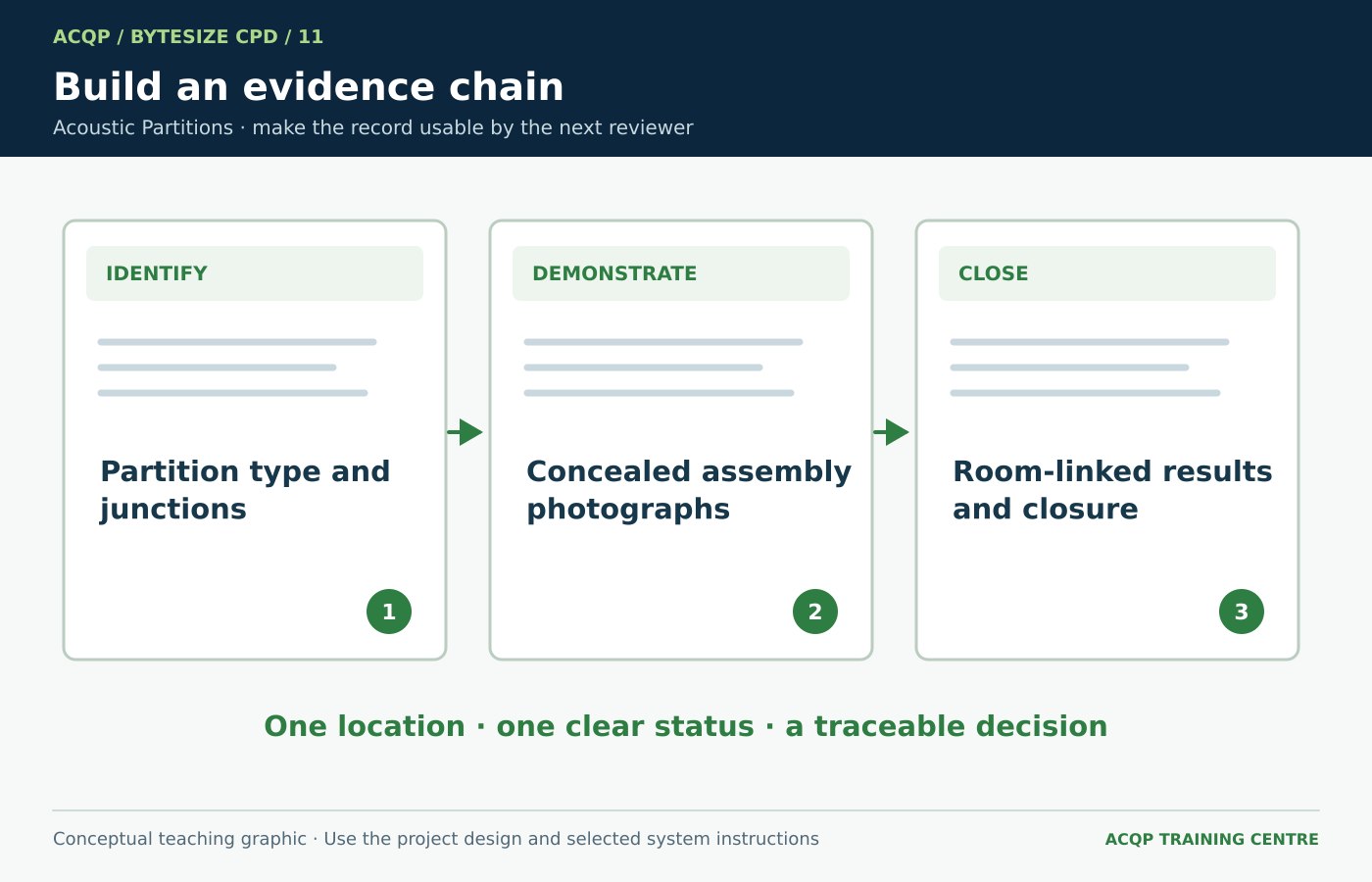
Drylining and acoustics · 20 MINUTE CPD
Acoustic Partitions: Junctions, Penetrations and Flanking Paths
Follow sound paths around and through a partition, and inspect the hidden details that a finished painted surface cannot reveal.

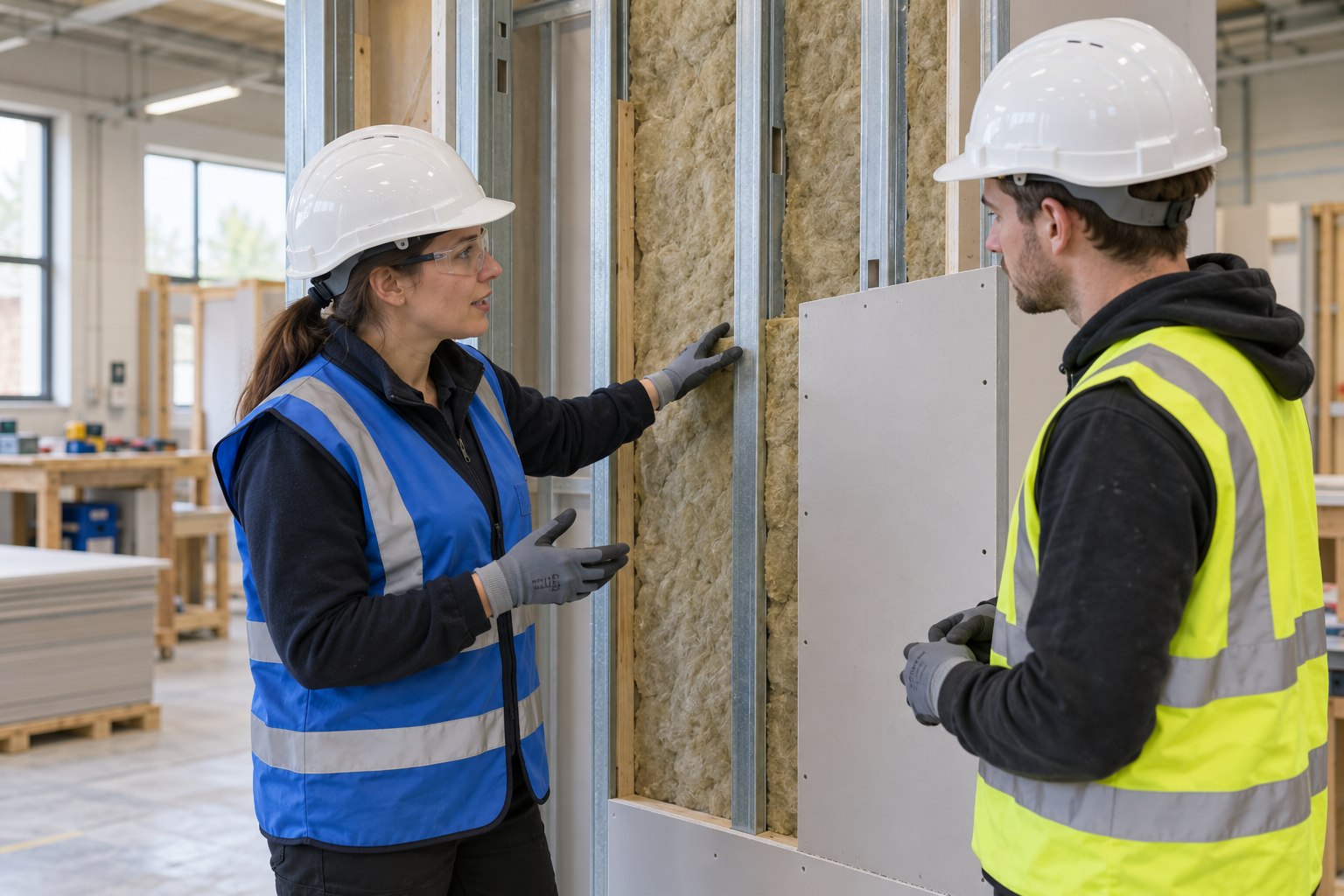
Follow sound paths around and through a partition, and inspect the hidden details that a finished painted surface cannot reveal.
Your 20-minute activity: allow 10 minutes for the article and illustrations, five minutes for the site scenario and five minutes for reflection. Record your actual learning time.
Regulatory references are for England. Use the editions and transition arrangements applicable to the project. Manufacturer examples apply to the named systems. The practical inspection exercises are ACQP teaching applications, not installation instructions.
1. Identify the specified partition system
British Gypsum’s White Book treats partition performance as the result of a specified system. Board layers, framing, insulation and the associated details work together. A board described as acoustic does not, by itself, establish the performance of the complete wall.
British Gypsum: White Book system specification overview
Find the partition type on the current plan and obtain its full specification. Record the rooms or spaces it separates and any changes along its length. Ask whether the head, base, abutments and services have been coordinated. A generic detail from a different partition may look similar while relying on different components or conditions.
2. Look for paths around the partition
British Gypsum’s system-design guidance distinguishes sound passing through the separating construction from flanking transmission through adjoining elements. It also explains that laboratory sound-insulation values do not directly describe every completed site condition.
British Gypsum: White Book system-design principles, acoustics
Trace the junctions with floors, ceilings, external walls and structural members. Ask whether the partition continues to the intended boundary and how adjoining voids are treated. Record the actual interface rather than inferring it from the room finish. If the arrangement differs from the acoustic design, request a coordinated review; adding another board layer is not automatically the answer to a path around the wall.
3. Inspect the hidden assembly
The selected partition system provides the basis for checking the concealed work. Component identity, board arrangement and the specified perimeter treatment need to be reviewed at stages when they can be seen, using the manufacturer’s details for that system.
British Gypsum: White Book system specification overview
Agree the inspection sequence with the drylining team. Record the wall reference before the final side closes and include the head, base and abutments. Note gaps, substitutions or unexpected rigid connections for review. Do not pull apart a completed system or change fixing arrangements casually; obtain the correct technical instruction and record the affected area.
4. Coordinate the services
British Gypsum’s service-penetration guidance states that openings must be detailed to preserve the required system performance, including acoustic separation, fire resistance and structural integrity. An acoustic treatment and a fire-resisting penetration seal are not interchangeable simply because both fill a visible opening.
British Gypsum: Service penetrations in its systems
Review the actual service type, opening and partition construction against the coordinated detail. Ask how back-to-back boxes, grouped services or late openings have been addressed by the designer. Record the arrangement before boxing or decoration hides it. Where separate trades provide the wall and the seal, make the inspection boundary explicit so neither assumes the other has verified the complete interface.
5. Use results at their proper scale
A product’s laboratory rating, a completed-building sound test and a workmanship inspection provide different kinds of evidence. British Gypsum’s acoustic guidance makes clear that junctions and site conditions influence the achieved result.
British Gypsum: White Book system-design principles, acoustics
Where testing is required, link the report to the exact rooms, wall types and building condition. Record exceptions and corrective work rather than assuming one result proves every partition. If performance is unsatisfactory, seek an acoustic investigation of the possible paths before proposing a cosmetic repair. Retain the accepted remedy and any required retest so the record shows how the original concern was resolved.
Site scenario
A partition uses the specified boards and insulation. Above the ceiling, it stops short of the intended soffit, leaving a shared void between two rooms. The installer proposes adding an extra layer of board below the ceiling.
Pause and consider: Which sound path does the proposed work address, and which unresolved interface needs design review?
Suggested response: The proposal changes part of the direct wall path but does not, by itself, resolve the route through the shared void. Compare the head condition with the acoustic and fire design, obtain the coordinated detail and record the agreed correction before concealment. Identify any testing required by the project; do not infer the final result from board count alone.
Take this to your next inspection
Inspect one partition head and one service penetration before the ceiling or final lining conceals them.