Concrete workmanship · 20 MINUTE CPD
Concrete Quality: Delivery, Placement and Curing Evidence
Join the delivery docket, placement location and curing record into one traceable account of a concrete pour.


Join the delivery docket, placement location and curing record into one traceable account of a concrete pour.
Your 20-minute activity: allow 10 minutes for the article and illustrations, five minutes for the site scenario and five minutes for reflection. Record your actual learning time.
Regulatory references are for England. Use the editions and transition arrangements applicable to the project. Manufacturer examples apply to the named systems. The practical inspection exercises are ACQP teaching applications, not installation instructions.
1. Check the delivery before it becomes the structure
BRMCA’s site guide covers ordering, receipt, placing, compaction and curing as connected activities. The delivery information should be compared with the ordered concrete and the intended use. A wagon arriving at the correct address does not establish that its load is correct for every pour on the site.
BRMCA: Ready-mixed concrete, practical guide for site personnel
Before discharge, identify the pour reference and the person checking the docket. Record the load identifier and the actual placement area. Where several mixes or pours are active, make the allocation explicit. If information is inconsistent or missing, follow the agreed acceptance process with the supplier and responsible project team before using the affected load.
2. Control changes at the point of use
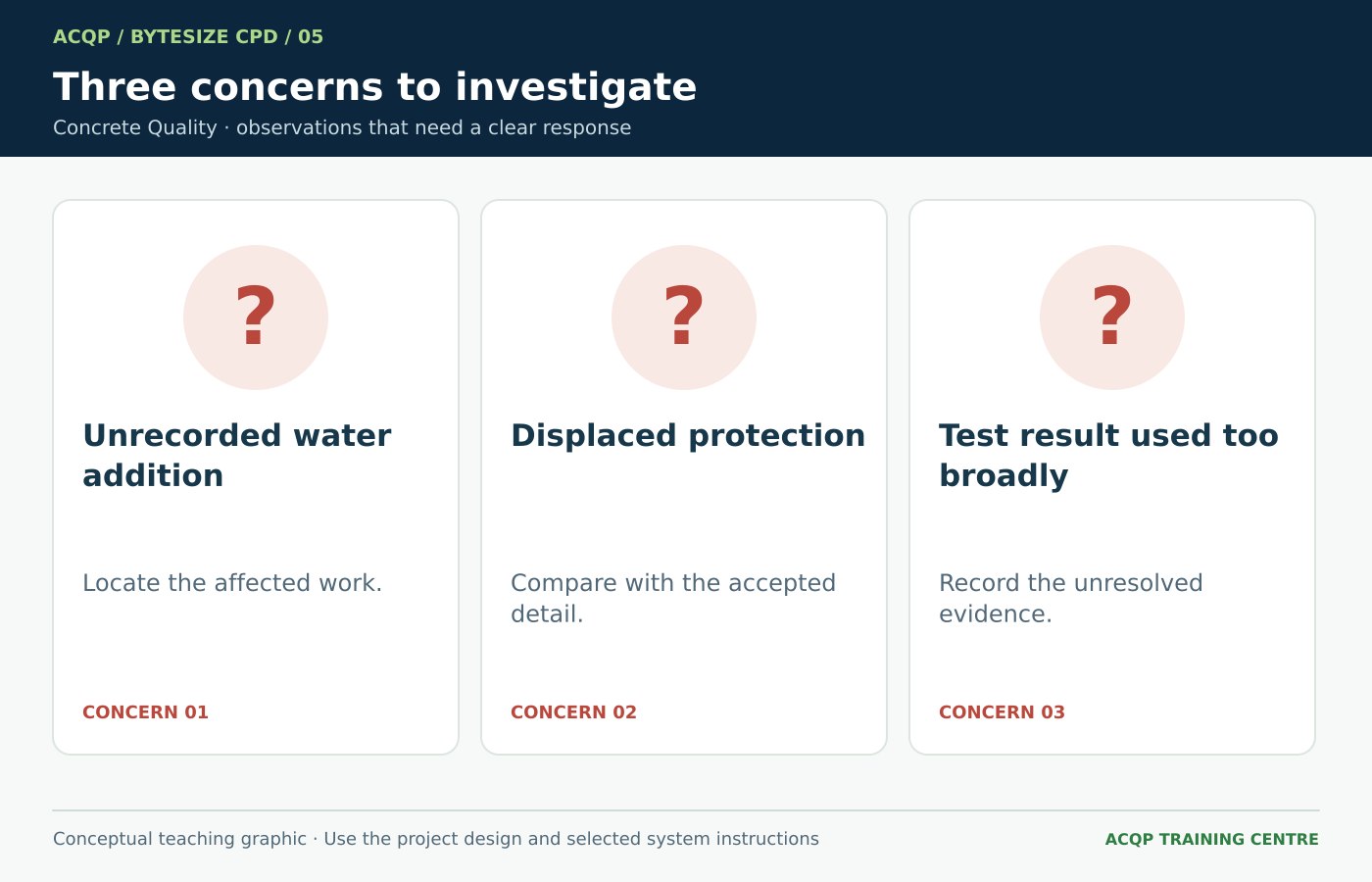
Adding water changes the delivered concrete. BRMCA discusses controls on water addition and the need to record relevant delivery and site information. A site preference for easier handling is not, by itself, authority to alter the mix.
BRMCA: Ready-mixed concrete, practical guide for site personnel
Ask who may authorise an adjustment under the supply and project procedure and what must be recorded. If an adjustment occurs, preserve the communication and load details rather than leaving an unexplained note. The inspector should also distinguish what was directly observed from what was reported later. Do not retrospectively sign a check that was never witnessed.
3. Plan curing as part of the pour
The Concrete Society explains that curing protects concrete from premature moisture loss. Methods can include suitable coverings or curing compounds, with the method maintained effectively. A sheet laid down and then blown away is not the same as continuous protection.
The Concrete Society: Curing concrete
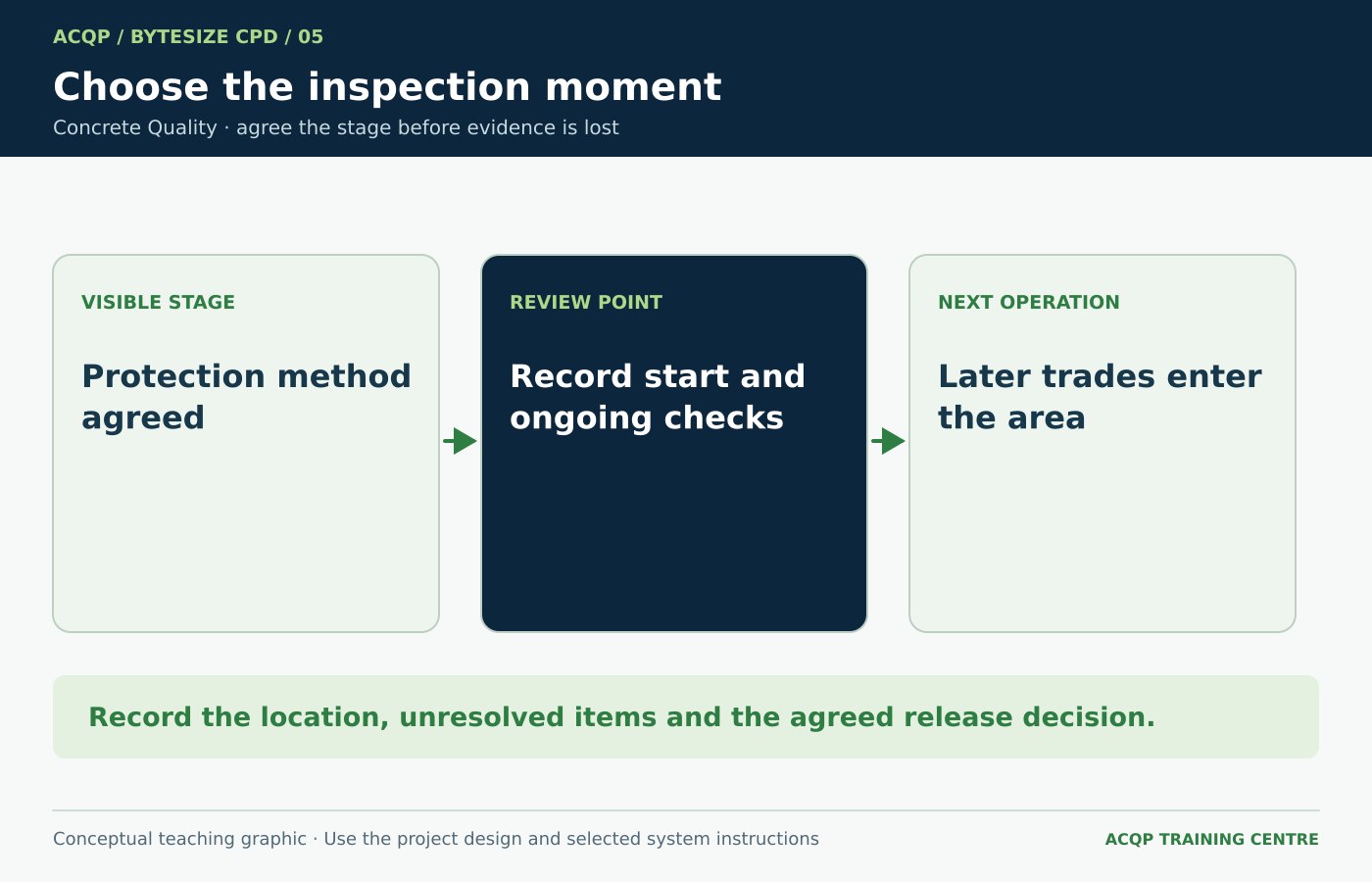
Before placement, ask which curing method is specified, who will apply it and who will check it during subsequent shifts. Note the planned duration and the basis for it in the project specification. Confirm compatibility with later finishes where a curing compound is proposed. Include exposed edges and difficult access areas in the discussion instead of relying on the appearance of the centre of the slab.
4. Observe conditions, not only paperwork
Curing effectiveness depends on the condition of the protection as well as the fact that it was initially provided. The Concrete Society notes, for example, that wet coverings must be kept wet rather than allowed to dry and draw moisture from the surface.
The Concrete Society: Curing concrete
Record the actual method, start time, checks and any interruption. Use photographs to locate displaced covers or damaged protection and note the action taken. Ask the responsible concrete specialist to assess the consequence of a significant interruption. Avoid diagnosing strength or durability from surface colour alone, and avoid treating a repair coating as an automatic answer to an unknown early-age condition.
5. Link test results to the right question
A specimen report relates to the identified sample and test conditions. It should not be used as a substitute for records of placement, compaction, curing or the actual condition of every part of the member.
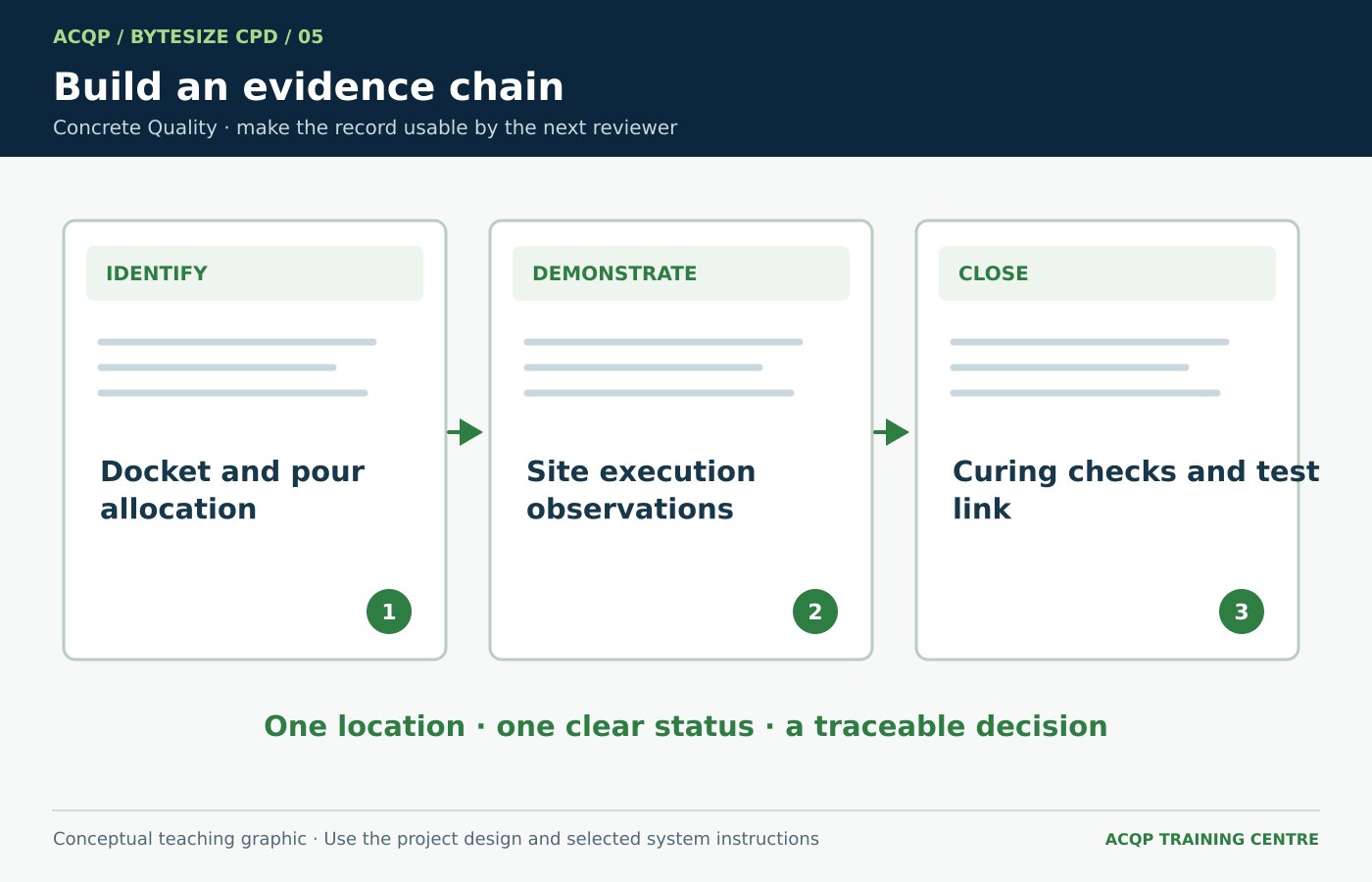
Create a clear chain from load to placement area to sample, where sampling is required. Keep execution records and later observations alongside the laboratory report. If a result or site observation raises concern, identify the affected pour and seek the specified technical assessment. Record limitations honestly: a successful result does not make an undocumented curing interruption disappear.
Site scenario
The delivery docket matches the slab specification and the sampled concrete later meets the stated test criterion. Overnight wind displaced the curing sheets from one corner, but no one recorded how long that area was exposed.
Pause and consider: Which question does the specimen result answer, and which question still needs a site-specific review?
Suggested response: The specimen result addresses the tested sample under its recorded conditions. The exposed corner raises a separate execution concern. Identify its location, reconstruct the timing as far as reliable evidence permits, record the uncertainty and request the concrete specialist’s assessment. Keep the result and the curing review together without describing one as a substitute for the other.
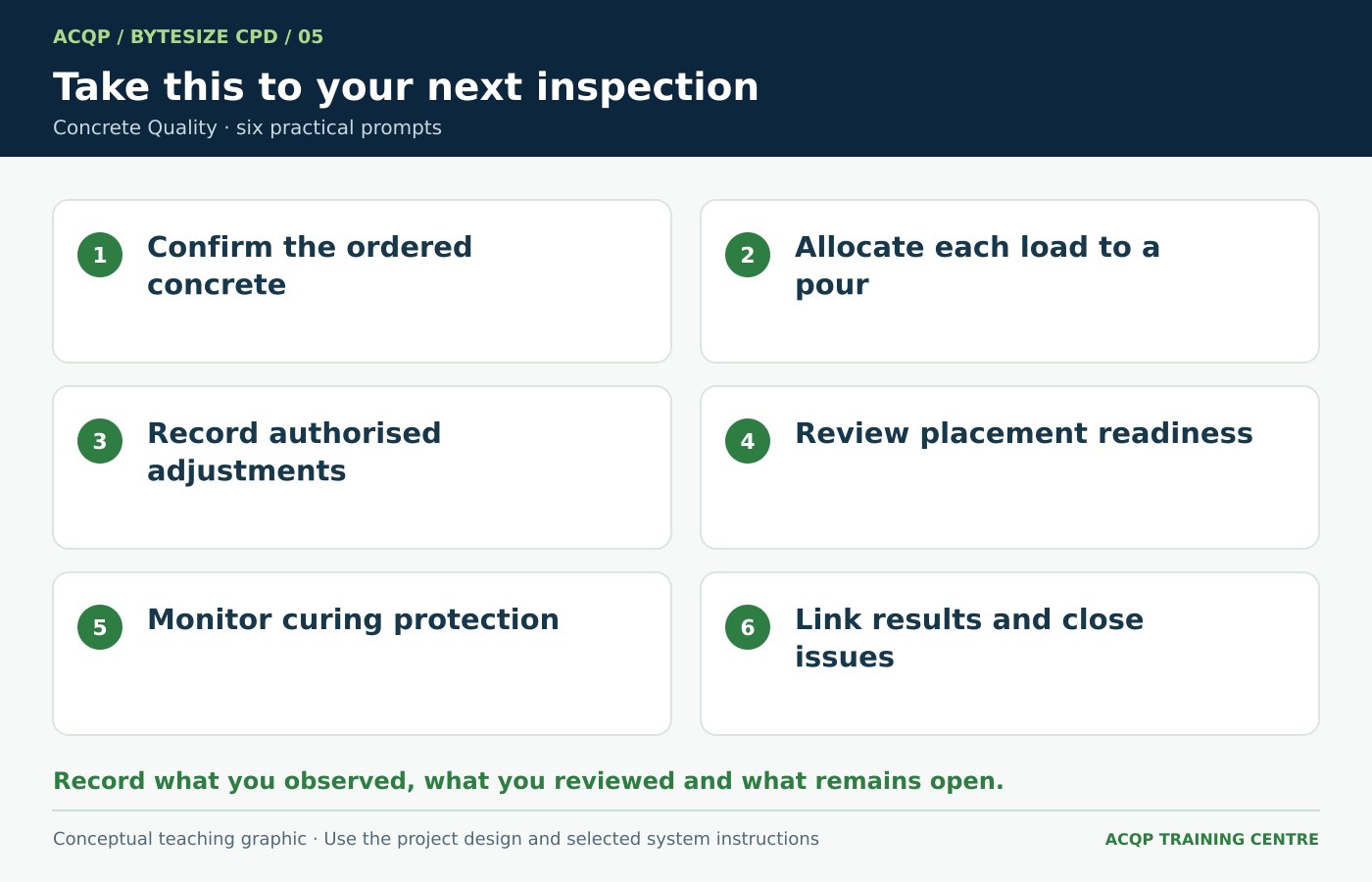
Take this to your next inspection
Add a location-linked curing check to one pour record after the placing gang has left.