ACQP Training Centre NOCN Approved Centre No. 30004857

ONLINE CONSTRUCTION TRAINING

Hidden spaces.
Critical details.

Cavity Barriers Fundamentals. Extended learning on concealed routes, closed and open-state systems, installation interfaces and the evidence needed before work is hidden.

12 extended modules · 12 photos · 24 diagrams · Assessment & certificate
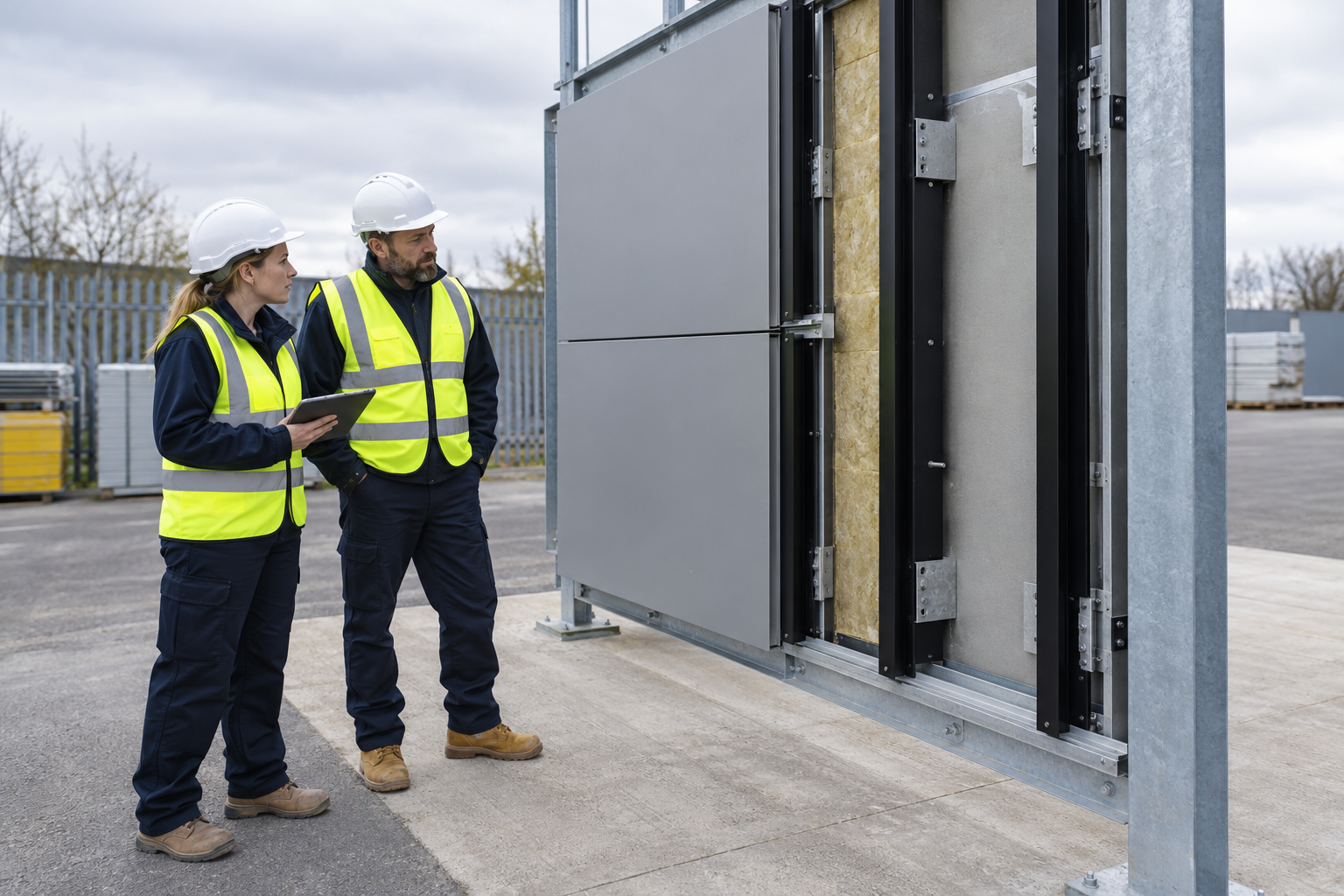
Two construction quality professionals review an accessible façade training bay at ground level
IDENTIFY. COORDINATE. VERIFY.Follow the route. Check the connection.
COMPLETE ONLINE COURSE£15.00Assessment & certificate included
ACQP CPD AccreditedACQP CPD Accredited CourseACQP Training Centre

Detailed learning, worked site examples and a QR-verified certificate.

THE COMPLETE CAVITY ARRANGEMENT

Identify the function.
Follow the continuity.
Keep the evidence clear.

For operatives, supervisors, site managers, Clerks of Works, façade and masonry teams, and facilities professionals who need a stronger understanding of cavity barriers.

UNDERSTAND

Start with the system.

Concealed cavities, requirements, product evidence, closed and open-state operation, supporting construction and the actual wall build-up.

COORDINATE

Resolve the interfaces.

Masonry cavities, rainscreens, openings, roof voids, horizontal and vertical junctions, fixings, movement, ventilation and drainage.

VERIFY

Check before concealment.

Readiness, hidden stages, useful photographs, damage, supported repairs, later attachments and location-based handover records.

A neat finish does not reveal the condition of the concealed barrier.

Develop practical awareness and structured quality decisions. Use current project requirements, actual system evidence and the appropriate competent review.

Course scope and references
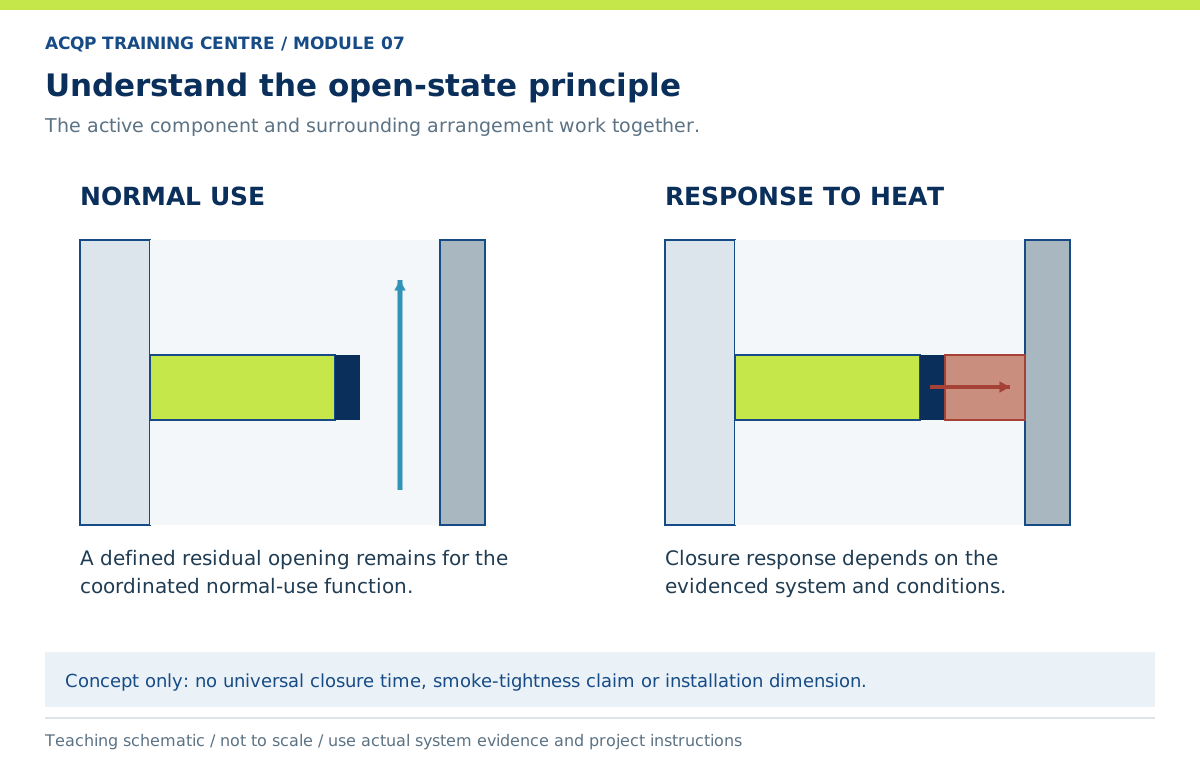
Concept diagram distinguishes an open-state barrier in normal use from its system-specific heat response

MORE DEPTH IN EVERY MODULE

Read the explanation.
Work through the example.
Apply the learning.

  • More than 12,700 words of core teaching content.
  • Over 1,000 words in every module, organised into eight sections.
  • A different photo and two diagrams in every module: 36 lesson images.
  • Worked scenarios, practical reflection and two knowledge checks per module.
  • Six downloadable site records and a four-location case study.
View the learning programme

YOUR LEARNING JOURNEY

Twelve extended modules.

Allow approximately 3–4 hours including exercises, images and assessment. Study at your pace, use the section links and return to saved progress. Record your actual learning time for CPD.

01Concealed cavities and the role of barriers

Understand concealed cavities and the different roles of fire-protection components.

  • Explain why concealed routes need attention.
  • Distinguish cavity barriers, closers, insulation and penetration seals.
  • Recognise open-state and closed arrangements.
Extended reading · Photo & diagrams · Two checks
02Requirements, responsibilities and project scope

Connect project requirements to clear responsibilities and decisions.

  • Identify jurisdiction, applicable guidance and current project information.
  • Distinguish design, installation, inspection and training evidence.
  • Allocate interface responsibilities and record decisions.
Extended reading · Photo & diagrams · Two checks
03System evidence and product selection

Compare actual construction with product-specific evidence.

  • Distinguish product, test, classification and installation information.
  • Check supporting construction, orientation, geometry and interfaces.
  • Control substitutions and out-of-scope conditions.
Extended reading · Photo & diagrams · Two checks
04Barrier layouts and design coordination

Make the barrier layout buildable, traceable and inspectable.

  • Read elevations, sections and interface details together.
  • Coordinate rails, brackets, services and construction sequence.
  • Use first installations and hold points effectively.
Extended reading · Photo & diagrams · Two checks
05Supporting construction, fixings and movement

Check the support, cavity, fixing and movement conditions.

  • Identify the actual supporting construction and its condition.
  • Record cavity geometry and relevant fixing requirements.
  • Recognise movement, storage and protection questions.
Extended reading · Photo & diagrams · Two checks
06Masonry cavities and opening surrounds

Understand masonry-cavity and opening-surround interfaces.

  • Distinguish ordinary closers from evidenced combined products.
  • Coordinate barriers with trays, drainage and other moisture functions.
  • Check joints and opening interfaces before concealment.
Extended reading · Photo & diagrams · Two checks
07Ventilated façades and open-state barriers

Understand open-state operation within ventilated façades.

  • Separate total cavity width from the designed residual gap.
  • Check active edges, opposing faces and product orientation.
  • Preserve the coordinated ventilation, drainage and fire arrangement.
Extended reading · Photo & diagrams · Two checks
08Continuity, joints and changes of direction

Follow continuity through joints, corners and terminations.

  • Review horizontal and vertical arrangements using their own evidence.
  • Identify unsupported joints, interruptions and abutments.
  • Record the actual connection rather than separate straight lengths.
Extended reading · Photo & diagrams · Two checks
09Openings, roof voids and façade interfaces

Recognise interfaces at windows, roof voids and other façade systems.

  • Distinguish cavity treatment from compartment and curtain-wall junctions.
  • Identify roof, opening and internal-void coordination questions.
  • Control the effect of attached elements and changed openings.
Extended reading · Photo & diagrams · Two checks
10Installation quality, inspections and records

Plan inspections and obtain useful evidence while work is visible.

  • Define readiness, installation and pre-concealment checks.
  • Take location-linked photographs with clear evidential limits.
  • Separate inspection, release, acceptance and defect closure.
Extended reading · Photo & diagrams · Two checks
11Defects, repairs and later alterations

Manage defects and changes through supported corrective work.

  • Record the current condition and its limitations.
  • Plan repair, access and reinstatement through the responsible teams.
  • Preserve history and verify later alterations.
Extended reading · Photo & diagrams · Two checks
12Handover, maintenance and a four-location case study

Create usable handover information and resolve four location-based decisions.

  • Link actual locations to current evidence and status.
  • Keep missing evidence and alterations visible at handover.
  • Plan future work using the installed-system record.
Extended reading · Photo & diagrams · Two checks

SIMPLE FROM START TO FINISH

Your course in four steps.

01

Create your account

Register and verify your email through the shared learner account.

02

Pay £15.00

One payment through Stripe. Assessment retakes and the certificate are included.

03

Learn and pass

Complete 12 modules and achieve at least 20 out of 24 in the final assessment.

04

Keep your record

Download your PDF certificate with its unique number and QR verification link.

A RECORD OF YOUR LEARNING

Your ACQP Training Centre certificate.

Your name, course title, completion date, result and unique certificate number on a landscape PDF.

  • QR verification of the certificate record
  • Three-year ACQP certificate period from completion
  • ACQP CPD Accredited course branding
  • NOCN Approved Centre No. 30004857

This course assesses awareness and knowledge. It does not qualify someone to design, install, inspect, repair or certify cavity barriers. NOCN approval relates to the Training Centre; this ACQP course is not an NOCN qualification.
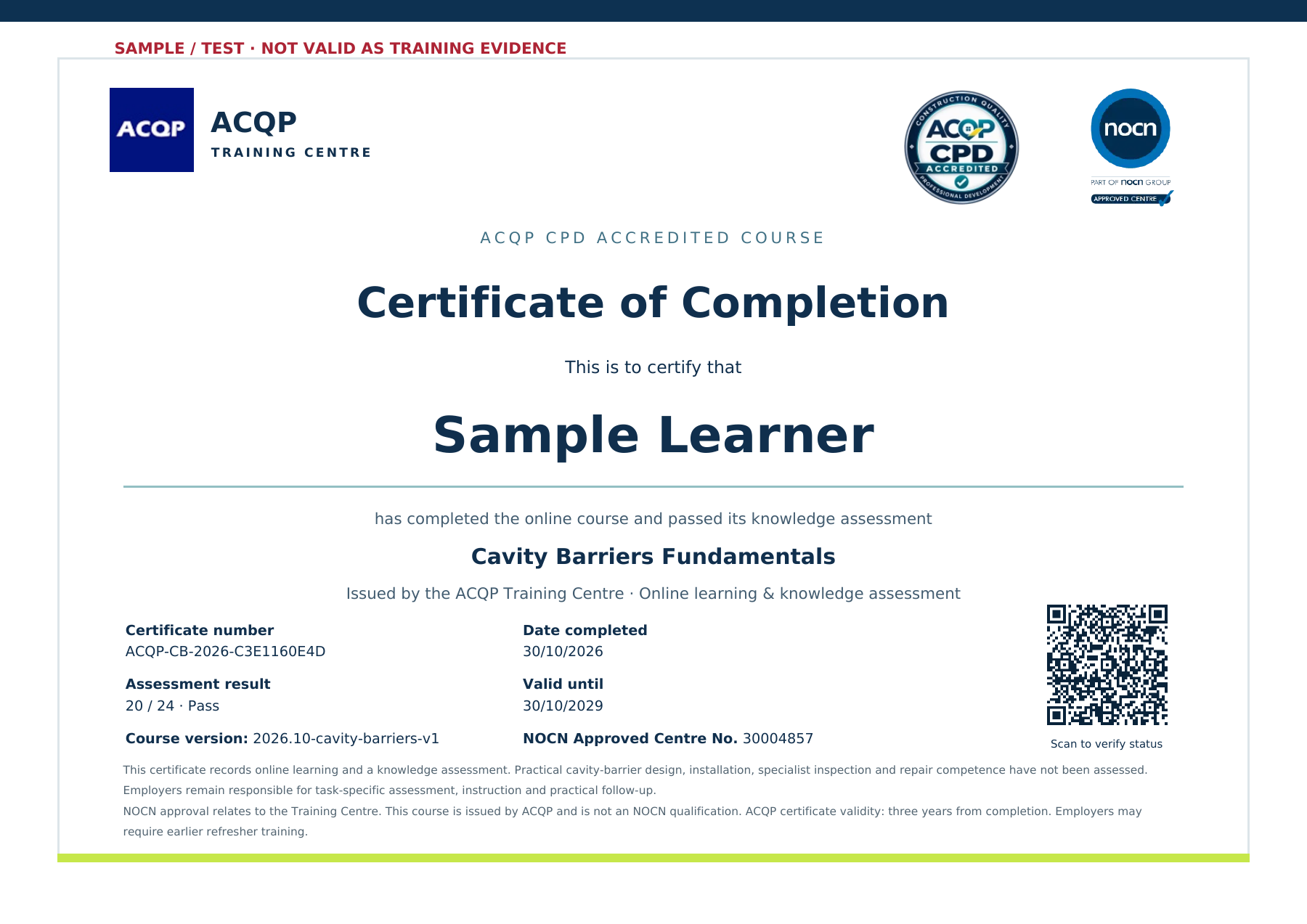
Sample Cavity Barriers Fundamentals completion certificateSample certificate · not valid as training evidence

BEFORE YOU BEGIN

Useful questions.

How detailed are the modules?

Every module has more than 1,000 words of core teaching, eight reading sections, a different photo, two diagrams, practical reflection and two checks. The final module works through four locations with different evidence, gap, junction and alteration decisions.

Does it cover open-state cavity barriers?

Yes. It explains normal-use openings, the heat-response principle, the difference between total cavity width and residual gap, product orientation and opposing construction. Actual installation requirements must come from the selected system evidence.

Does this teach universal gaps or fixing patterns?

No. Cavity geometry, compression, gaps, supports, fixings and junctions depend on the selected system and project. The course explains what to identify, compare, record and refer for a competent decision.

What workplace resources are included?

Six printable records cover identity and evidence, layout coordination, pre-start checks, installation and hold points, defects and alterations, and handover. A worked four-location case study is also included.

Can I learn on my phone?

Yes. Pages adapt to smaller screens, section links help navigation, and lesson images can be opened at full size. Completed modules are saved to your learner account.

What if I do not pass first time?

Review the modules and try again. Retakes are included, subject to reasonable attempt limits. There is no assessment countdown.

Contact colchester@acqp.co.uk for course support.

CAVITY BARRIERS FUNDAMENTALS

Understand what is hidden.
Make the evidence clear.

Start your course · £15.00